Precision begins before the first incision.
A unified environment for imaging analysis, AI-assisted planning, surgical simulation, and multidisciplinary collaboration — transforming radiological data into actionable surgical intelligence.
- 8
- Workflow stages
- 3
- Specialty suites
- 1
- Unified platform
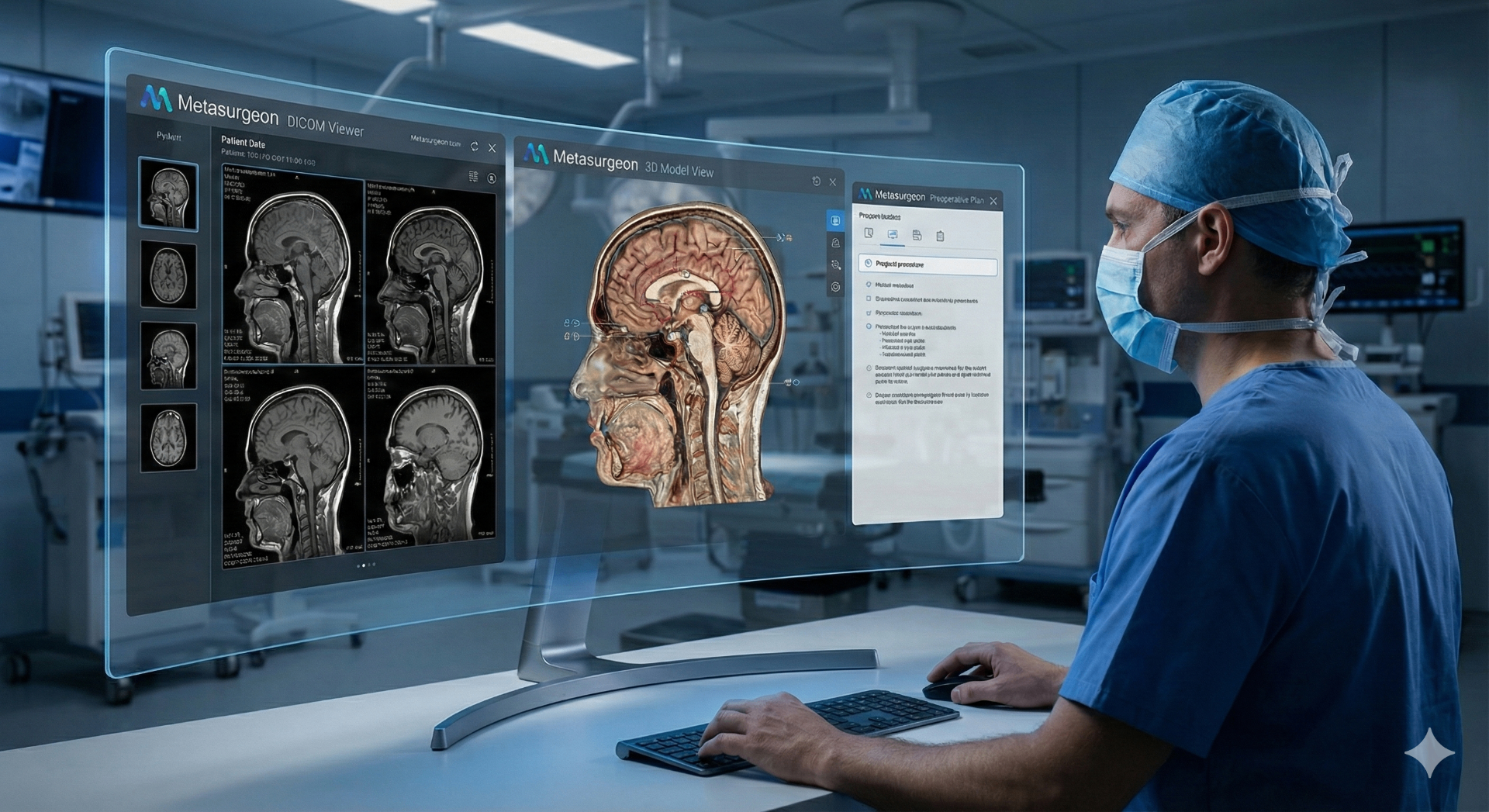
Fig. 01 — Single Workflow
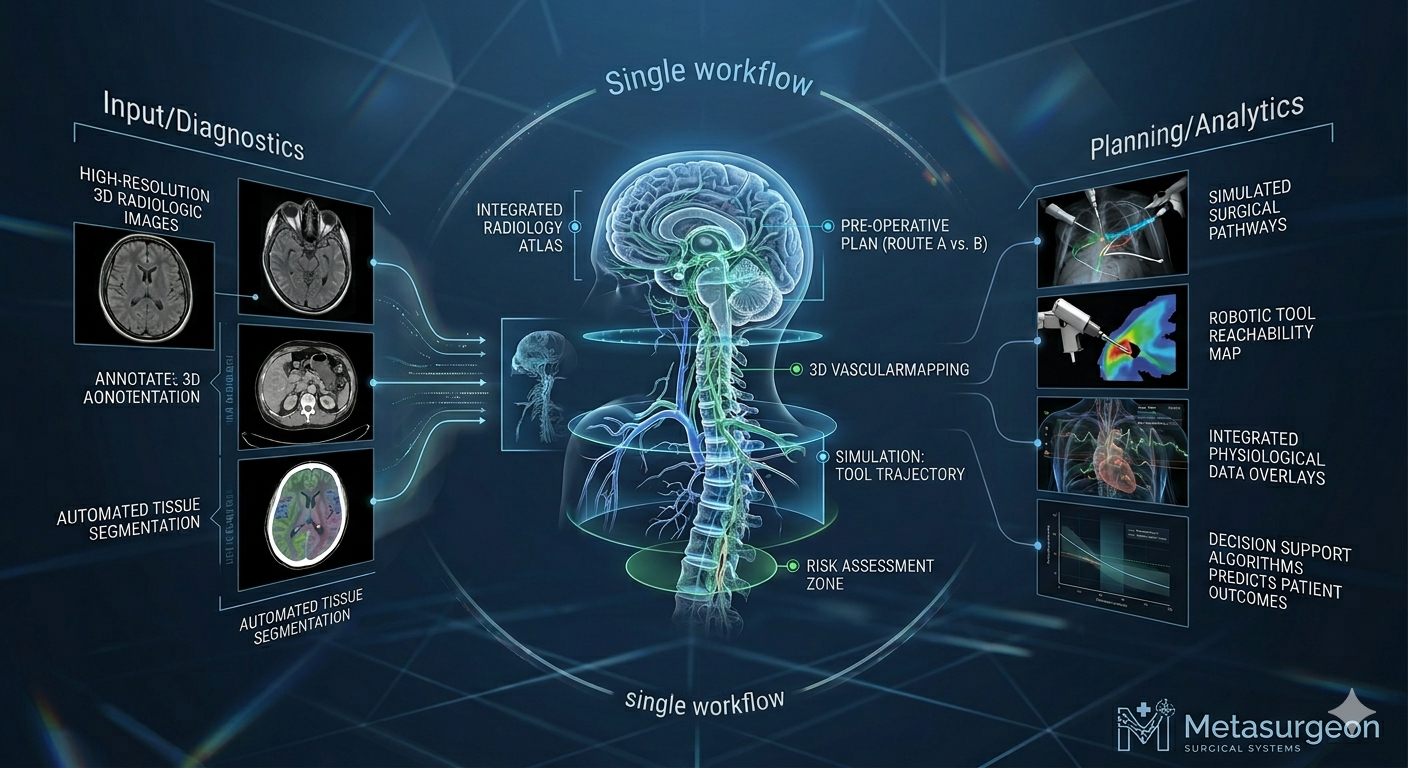
Transforming Imaging
From radiology
to surgical strategy.
Modern surgery is no longer planned with static images and subjective estimation. The Metasurgeon platform converts multimodal imaging into a decision-grade surgical intelligence layer — anatomy visualized, procedures simulated, risks anticipated, outcomes optimized before the first incision.
Advanced visualization, AI-assisted analysis, patient-specific 3D reconstruction, trajectory simulation and implant planning — unified across radiology, planning and intraoperative readiness.
- 11+
- Imaging modalities
- <2 min
- AI segmentation
- 1
- Unified workflow
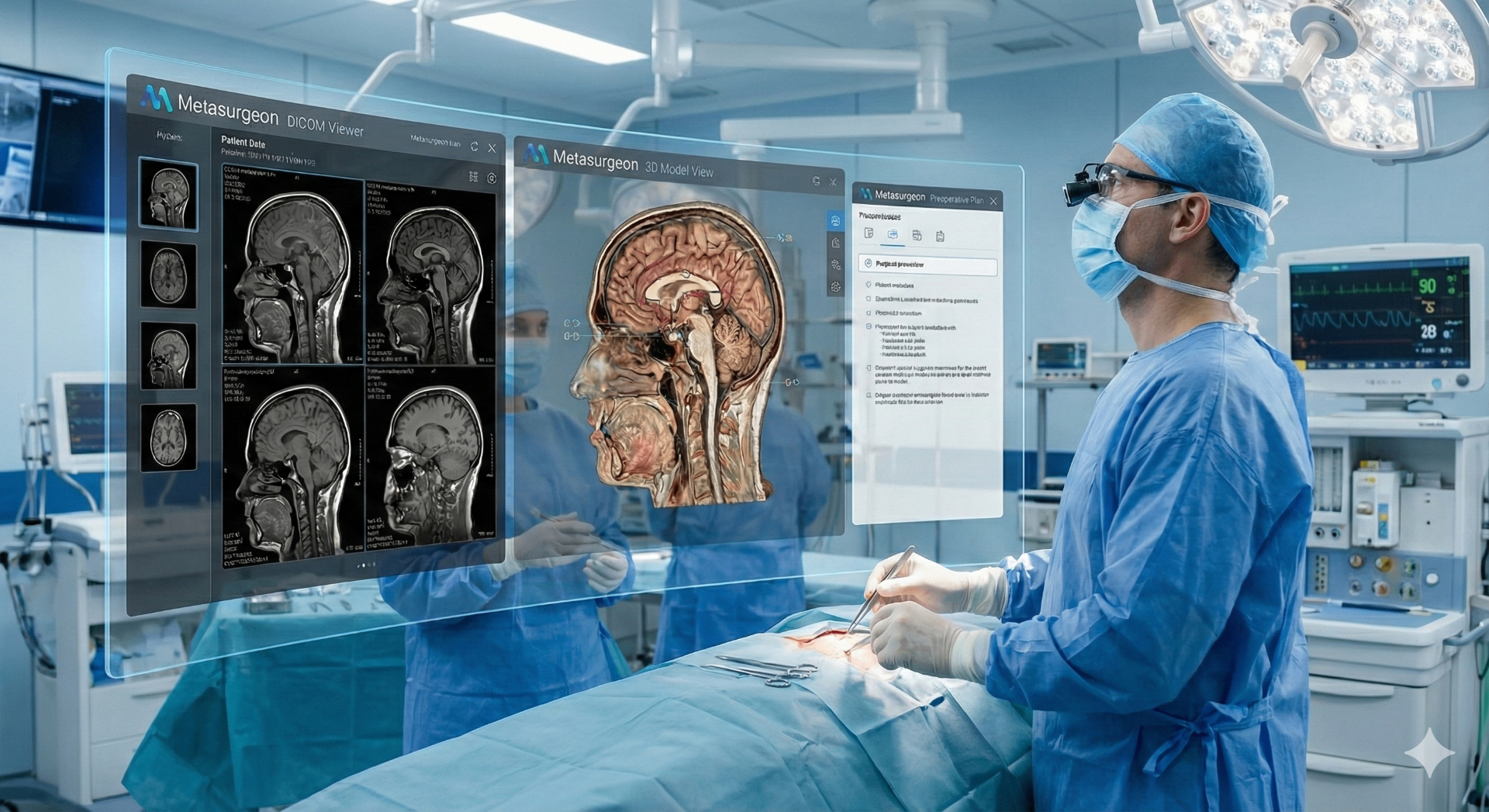
Fig. 02 — Intraoperative Continuum
Clinical Value
Outcomes that
change the OR.
Preoperative planning is no longer an enhancement — it is the foundation of precision-driven surgical care. Six measurable outcomes that reshape how surgical teams prepare, perform and review.
- Improved surgical precision and accuracy
- Reduced operating time and resource use
- Lower complication and revision rates
- Standardized, reproducible procedures
01 / 06
Enhanced Surgical Precision
Detailed anatomical analysis lets surgeons evaluate critical structures, define operative corridors, and optimize procedural approaches before surgery begins.
02 / 06
Reduced Operative Uncertainty
Preoperative simulation anticipates intraoperative challenges, minimizing unexpected findings and improving surgical preparedness.
03 / 06
Improved Patient Safety
Advanced planning identifies high-risk anatomical regions, reducing injury to critical neurovascular structures and surrounding tissues.
04 / 06
Optimized OR Efficiency
Structured planning workflows reduce intraoperative decision delays, contributing to shorter operating times and better resource utilization.
05 / 06
Personalized Surgical Strategy
Every plan is tailored to patient-specific anatomy, pathology, and procedural objectives using individualized imaging datasets.
06 / 06
Multidisciplinary Collaboration
Radiologists, surgeons, anesthesiologists and clinical teams collaboratively review imaging and planning data inside one platform.
Workflow architecture
Eight stages. One surgical pipeline.
A continuous flow from imaging acquisition through postoperative analytics — every stage engineered for clinical-grade precision.
- Stages
- 8
- Pipeline
- 1
- Modalities
- 11+
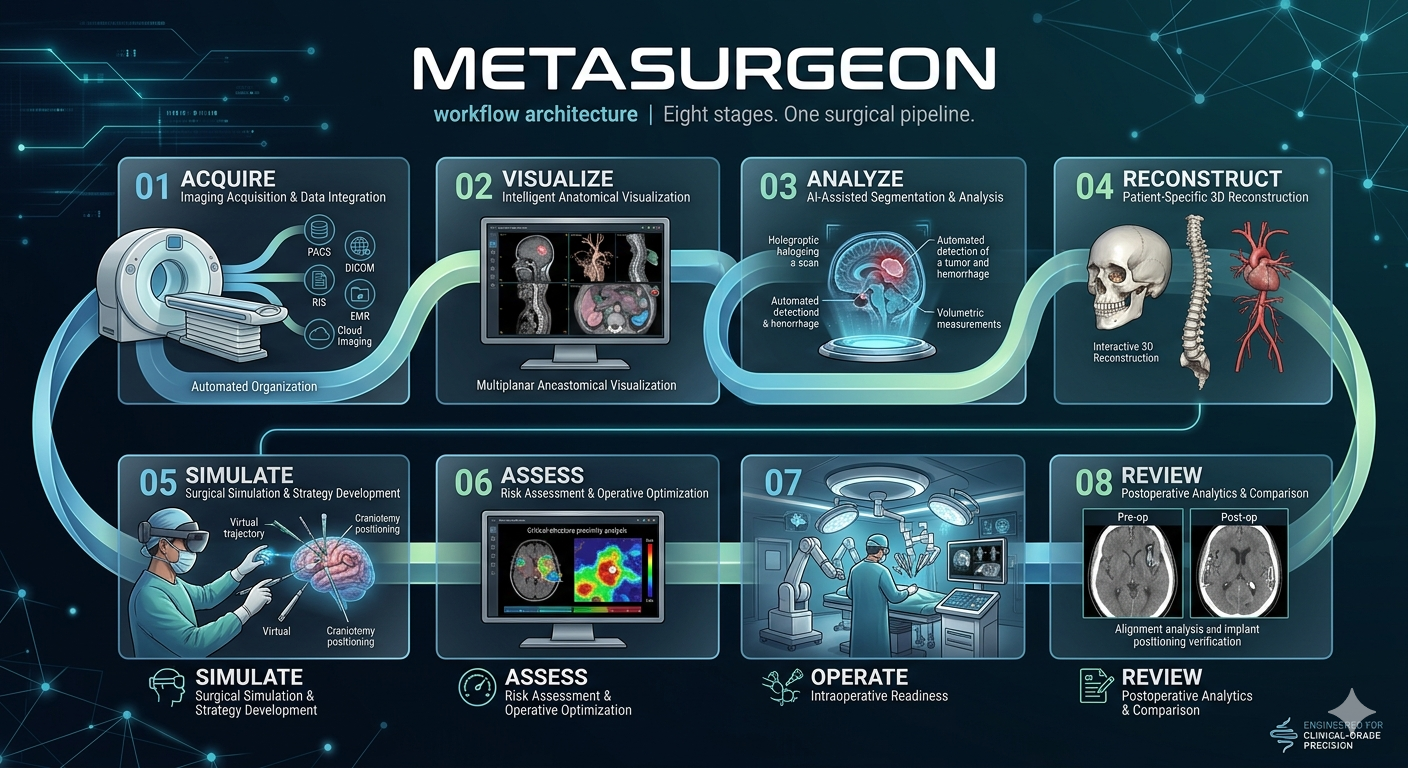
01 / Acquire
Imaging Acquisition
Studies pulled from PACS, DICOM, RIS, EMR and cloud — auto-organized per procedure.
02 / Visualize
Anatomical Visualization
Multiplanar, curved planar and fusion imaging at diagnostic resolution.
03 / Analyze
AI Segmentation
Automated detection of tumors, hemorrhage, fractures with volume and alignment metrics.
04 / Reconstruct
Patient-Specific 3D
Interactive bone, vascular, tumor and cranial models clarifying surgical access.
05 / Simulate
Surgical Simulation
Trajectories, craniotomies, screw paths and resections rehearsed before the OR.
06 / Assess
Risk Assessment
Critical-structure proximity, neurovascular risk and corridor safety scoring.
07 / Operate
Intraoperative Readiness
Plans sync with navigation, robotics, microscopes, AR/VR and intraoperative imaging.
08 / Review
Postoperative Analytics
Pre-op vs post-op comparison, alignment, implant and outcome documentation.
Specialty applications
Procedure-aware, not generic.
Templates, measurements and AI models tuned to the cases you actually perform — calibrated per specialty, per procedure, per surgeon.
- Specialties
- 3
- Templates
- 40+
- AI Models
- Tuned
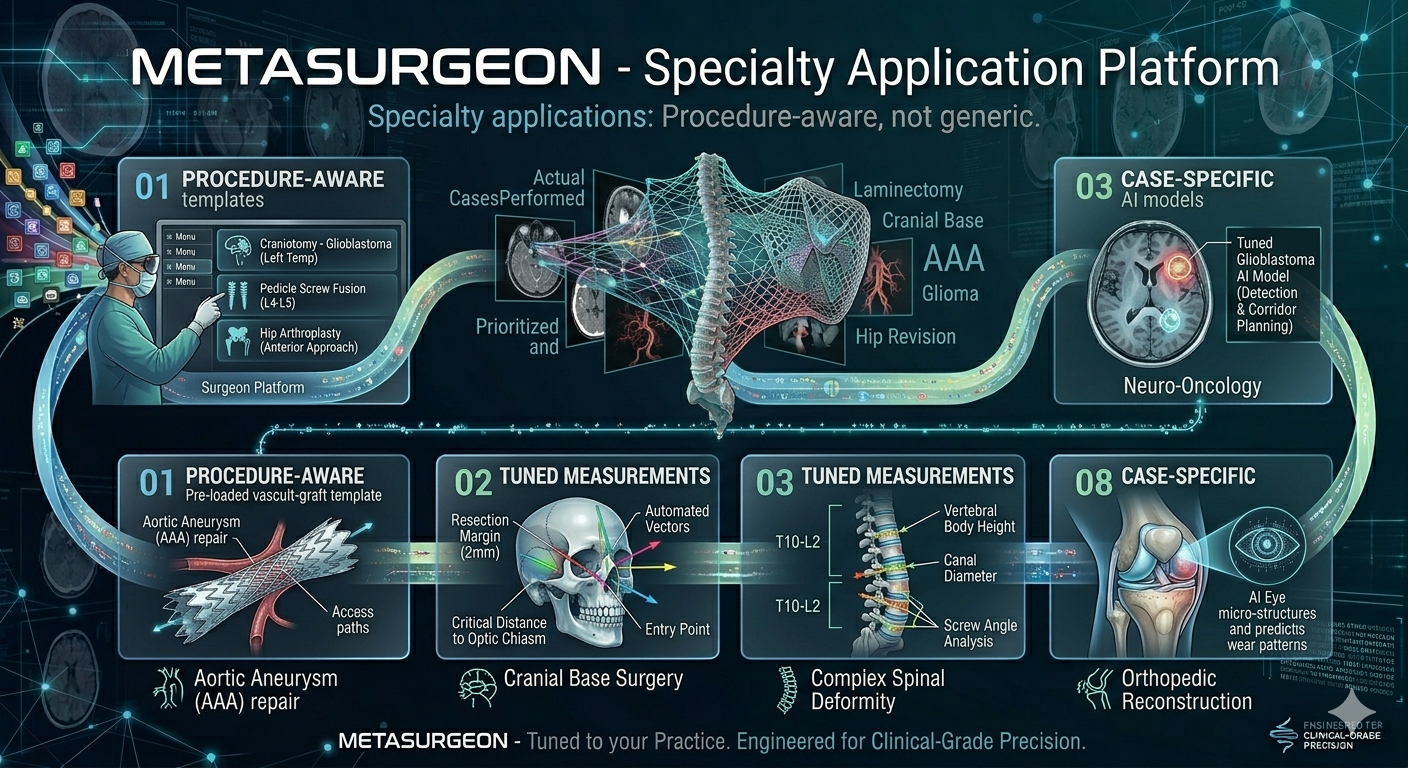
Brain · Vascular · Skull Base
Neurosurgery
- Brain Tumor
- Segmentation, cortical mapping, functional fusion.
- Skull Base
- Corridor planning and cranial nerve risk mapping.
- Cerebrovascular
- Vessel reconstruction, aneurysm metrics, clip simulation.
Degenerative · Deformity · Trauma
Spine Surgery
- Degenerative
- Automated stenosis and alignment measurements.
- Deformity
- Cobb, sagittal balance and rod simulation.
- Instrumentation
- Pedicle screw trajectory and breach-risk scoring.
Joint · Trauma · Alignment
Orthopedics
- Joint Replacement
- Hip, knee, shoulder templating with fit and alignment.
- Reconstruction
- Fracture reduction, plate and nail templating.
- Limb Alignment
- Axes, deformity analysis and osteotomy preview.
Patient-specific 3D
One patient.
One digital truth.
Imaging datasets become a complete digital representation of patient anatomy — brain, spine, vasculature, tumor and bone. The twin serves as the preoperative roadmap, the intraoperative guide and the postoperative comparison reference.
- 01Brain — cortical surface, deep nuclei, white-matter tracts
- 02Spine — vertebrae, pedicles, canal, foraminal volumes
- 03Vasculature — arterial tree, venous sinuses, perforators
- 04Tumor — gross volume, edema, infiltration zones
- 05Bone — fracture lines, defects, implant interfaces
Intraoperative readiness
The plan follows the patient into the OR.
Preoperative plans synchronize with intraoperative technologies for real-time procedural guidance — creating continuity between planning and execution.
- Surgical navigation systems
- Operating microscopes
- Robotics platforms
- Intraoperative imaging (C-arm, O-arm)
- AR / VR systems
- Endoscopic visualization
AR / VR
Anatomy where the surgeon needs it.
Augmented Reality
Overlay anatomical models on the patient for intraoperative guidance and navigation without breaking sterile flow.
Virtual Reality
Full surgical rehearsal on real patient anatomy — resident training, deformity visualization and skull-base corridor walkthroughs.
Enterprise advantages
Built for healthcare systems, not just departments.
Standardized Surgical Planning
Establish consistent planning protocols across departments and institutions.
Centralized Clinical Intelligence
All planning data, imaging studies, annotations and surgical strategies inside one unified ecosystem.
Remote Surgical Collaboration
Securely collaborate across hospitals, academic centers and remote locations.
Scalable Architecture
Single clinics, multi-specialty hospitals, enterprise healthcare networks and cloud deployments.
Operational benefits
Measurable impact for hospitals.
- Reduced OR Time
- Advanced planning decreases intraoperative uncertainty and procedural delays.
- Increased Throughput
- Efficient workflows support higher surgical capacity across departments.
- Better Documentation
- Structured planning strengthens clinical documentation and reporting.
- Training & Education
- Simulation-based planning enhances resident education and surgical preparation.
Future-ready
Designed for the next generation of surgical technology.
The platform is architected to evolve with the field — from AI guidance to autonomous measurement and digital surgical twins.
Positioning
Unified Surgical Intelligence Platform.
Most competitors do one thing — navigation, implants, PACS, or planning. Metasurgeon unifies the entire surgical lifecycle inside one ecosystem.
What we unify
Competes against
Preoperative planning is no longer an optional enhancement to surgery — it is becoming the foundation of precision-driven surgical care.
Get started
From image review to surgical strategy.
Transition from conventional image review to intelligent, data-driven surgical strategy — improving precision, safety, efficiency and outcomes across the entire surgical continuum.